
 Some instruments answer the specific questions they were built for, meeting narrow engineering targets and confirming established models. The James Webb Space Telescope does that too, but it also raises puzzles nobody anticipated. We now see galaxies shining far too early and far too bright in the first chapters of the universe. We watch the atmospheres of distant exoplanets being read molecule by molecule across interstellar gulfs, and we see chaotic star-forming regions resolved into intricate jets and rotating disks where infant planets assemble. NASA’s Webb mission pages document a staggering discovery rate, and astronomers widely describe it as a golden age of astrophysics, with each new image bringing another historic revelation into view.
Why infrared matters
- As the universe expands, it stretches the ancient light of the earliest, most distant galaxies into infrared wavelengths.
- Earth’s moisture-laden atmosphere blocks most of that band, so ground-based instruments are effectively blind to these signals.
- Astronomers needed an exceptionally cold telescope parked a million miles away at the second Lagrange point, shielded behind a tennis-court-sized sunshield.
- From there it can perceive what no ground-based instrument can.
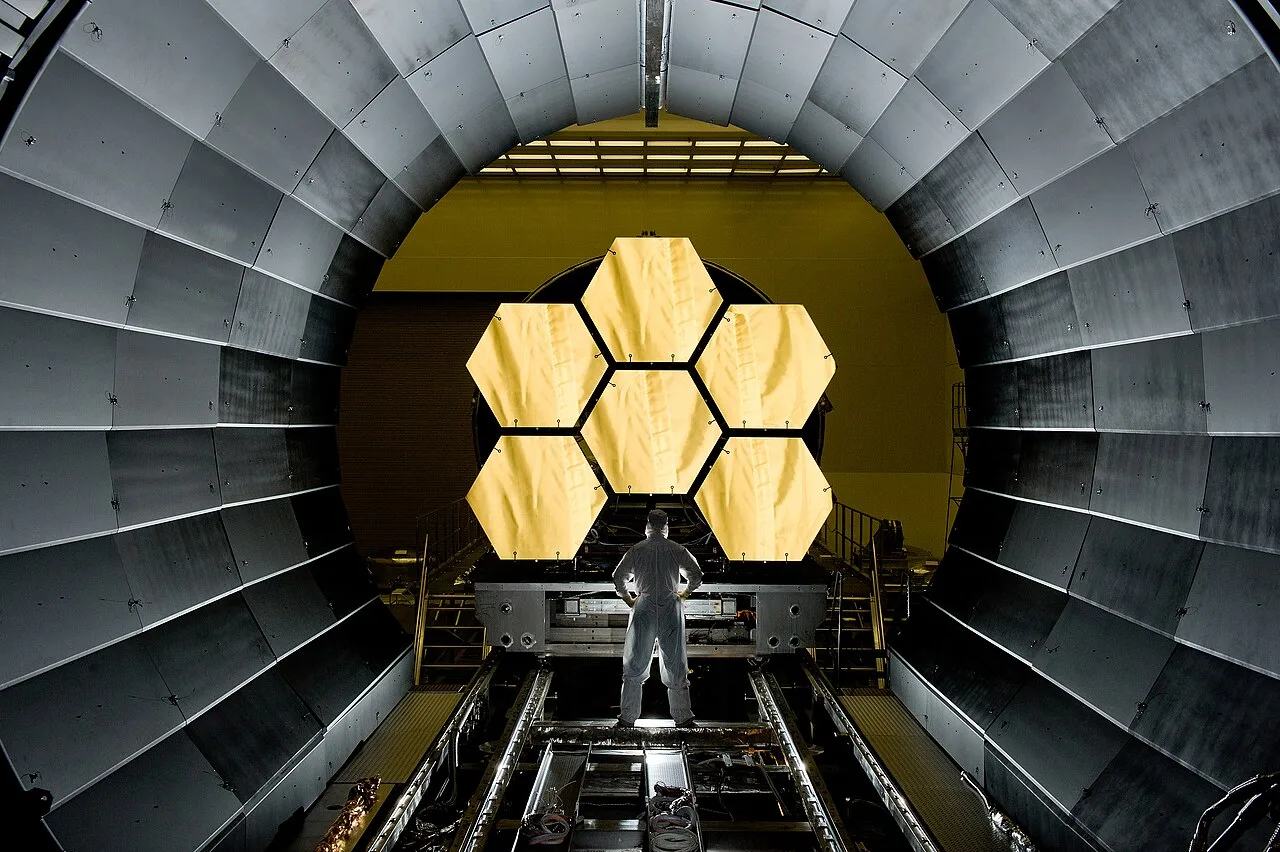
- Its eighteen hexagonal beryllium mirror segments, aligned to nanometre precision after reaching deep space, deliver a sharpness that still startles the engineers who built it.
New puzzles and discoveries
Early, oversized galaxies
- The early, oversized galaxies are a major puzzle for modern astrophysics.
- There are more of these massive objects than expected, and they existed earlier in cosmic history than standard models predicted.
- That isn’t necessarily a refutation of cosmology, but it forces theorists to build more sophisticated models of how fast structure can form in the young universe.
Exoplanets and our cosmic backyard
- Webb’s sensitive spectra of exoplanet atmospheres have detected water vapor, carbon dioxide, methane and complex chemistry that strongly suggests active geology and dynamic weather.
- Distant worlds are no longer mere points of unresolved light but environments with distinct physical conditions.
- Webb also investigates icy moons orbiting gas giants, distant Kuiper Belt objects at the frigid edge of the solar system, and the chemistry of planet-forming disks where the basic ingredients of biology assemble.
- Each competitive observing cycle is oversubscribed many times over, a clear measure of how much sky one great instrument opens up.
An open archive
Perhaps Webb’s least visible revolution is procedural: its raw and calibrated data becomes public with remarkable speed.
- The science archive is heavily mined by researchers who never took part in the original proposals, including graduate students, researchers at smaller universities and teams in developing countries without their own space programs.
- Machine-learning searches of the archive now routinely surface rare objects, faint transients and anomalies the original observers weren’t looking for.
- Citizen-science projects let thousands of volunteers classify millions of distant galaxies by hand.
In effect, the observatory’s aperture includes anyone with an internet connection and a burning question.
What comes next
- The next generation of instruments is already being debated and planned.
- Scientists are proposing even larger space telescopes to image Earth-like exoplanets directly, along with dedicated far-infrared and X-ray flagships that would work alongside the giant ground-based optical telescopes coming online.
- Each proposal carries the lesson Webb taught: a versatile general-purpose observatory more than repays its cost by making discoveries nobody budgeted for.
Give the universe a better eye and it has never disappointed human curiosity, so the queue of future telescopes is forming accordingly. Transformative telescopes define scientific generations because their data outlives the original engineering teams, and the archive becomes a public commons mined for decades. The Webb archive is already that kind of enduring inheritance. The sky, it turns out, was never quiet or empty; we simply lacked the eyes to see its complexity. Now those eyes are open, scanning the dark with clarity and purpose.