
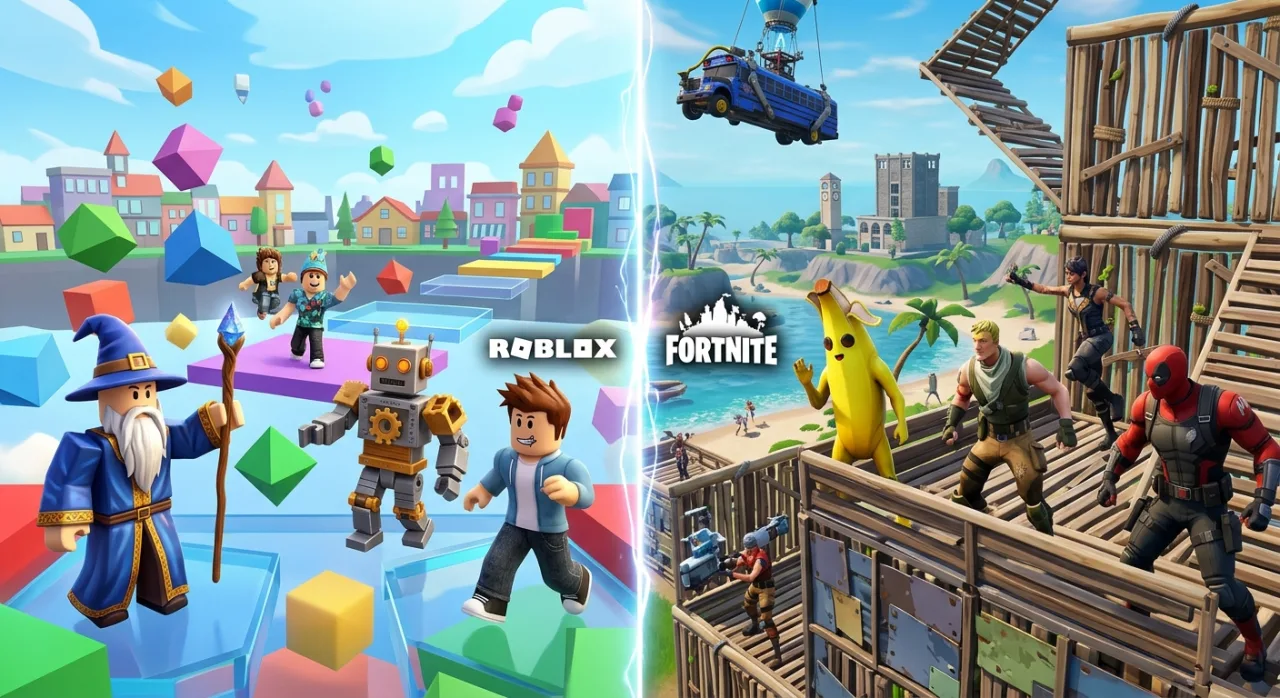
 Roblox and Fortnite anchor modern youth gaming culture. Both platforms started as traditional video games before evolving into expansive virtual worlds. Today, players log in to build custom environments, hang out with friends, attend live concerts, and trade digital assets. Despite sharing a focus on user-created experiences, their underlying business models, creator engines, and platform architectures operate in fundamentally different ways.
Below is an analytical breakdown of how both ecosystems compare across user engagement, creator monetization, content diversity, and platform culture.
User Base and Activity Metrics
Daily and Monthly Active Users
-
Roblox: Averaged 123 million Daily Active Users (DAUs) in Q2 2026 (a 10% year-over-year increase), down slightly from a peak of 132 million in Q1 2026. Its Monthly Active Users (MAUs) hover around 380 million.
-
Fortnite: Reached over 75 million MAUs as of mid-2026. While Epic Games boasts over 650 million registered accounts, this figure represents total historical sign-ups rather than regular active players.
Player Engagement Time
Roblox players logged 29 billion hours in Q2 2026, following a record 31 billion hours in Q1 2026 (a 43% year-over-year surge). Epic Games does not regularly disclose total hours logged for Fortnite, making direct playtime comparisons difficult, though community-made content continues to claim a larger share of player time each quarter.
Creator Economies Compared
Both platforms rely heavily on community creators to expand their library of playable experiences, but their tools, entry barriers, and compensation models differ sharply.
| Metric / Feature | Roblox | Fortnite (UEFN) |
| Monetization System | Developer Exchange (DevEx) | Engagement Payouts & In-Island Purchases |
| Total Creator Payouts | $1B+ in 2025 alone | $1B+ total since 2023 launch |
| Average Top Creator Earnings | ~$3.39 Million annually | Varies; top islands earn via direct in-island purchases |
| Total Published Units | 40M+ distinct experiences | 173,000+ custom islands |
| Active Creator Count | ~3.5 Million developers | ~70,000 active creators |
-
Roblox’s Open-Door Model: Anyone can publish a game instantly using Roblox Studio. This lower barrier to entry fuels an immense volume of indie and hobbyist developers.
-
Fortnite’s Curated Model: Powered by Unreal Editor for Fortnite (UEFN), Epic Games targets higher-fidelity development. Over 3,000 community islands now earn revenue directly through in-island transactions rather than engagement-only payouts.
Content Style and Game Variety
Roblox: The Interactive App Store
Roblox functions like a decentralized storefront for interactive software. Players switch seamlessly between obstacle courses (obbies), complex business simulators, and massive multiplayer role-playing games without leaving the client.
Fortnite: Expanding Beyond Battle Royale
Fortnite originated as a single-mode battle royale shooter. Through UEFN, it has expanded into custom racing tracks, horror adventures, and social lounges. In May 2026, community-built content accounted for 47% of all hours played in Fortnite, up from 38% the previous year. However, tactical shooting mechanics remain central to Fortnite’s core brand.
Monetization and Revenue Models
Roblox (FY 2025)     : $4.89B Revenue | $6.81B Bookings
Fortnite (Estimated) : $5.00B - $6.00B Annual Revenue
-
Roblox: Generated $4.89 billion in reported revenue for FY 2025 (with total bookings reaching $6.81 billion). Q2 2026 revenue hit $1.469 billion (a 36% YoY increase). Transactions are driven almost entirely by Robux, the platform’s virtual currency.
-
Fortnite: Epic Games keeps exact financials private, but industry estimates consistently place annual revenue between $5 billion and $6 billion. Income stems from V-Bucks, seasonal Battle Passes, character cosmetics, and an expanding share of spending inside community-made islands.
Target Audience and Platform Culture
-
Roblox Target Demographic: Skews younger, with a core player base under the age of 16. Its building tools appeal strongly to younger audiences looking to express creativity and hang out in casual environments.
-
Fortnite Target Demographic: Captures an older demographic of teenagers and adults who prefer competitive action and high-fidelity graphics. Fortnite leans heavily into pop-culture integrations, live virtual concerts, and major brand crossovers.
Summary Overview
Roblox leads in daily active user scale, total hours logged, and total creator volume due to its open-marketplace design. Fortnite counters with high graphical fidelity, massive pop-culture crossovers, and a development framework in UEFN that bridges the gap between casual modding and professional game development.
Frequently Asked Questions
1. Which platform has more daily active users, Roblox or Fortnite?
Roblox leads significantly, reporting 123 million Daily Active Users (DAUs) in Q2 2026. Fortnite reports over 75 million Monthly Active Users (MAUs), reflecting a smaller active daily audience.
2. How much have creators earned on each platform?
Roblox developers earned over $1 billion in 2025 through the Developer Exchange program. Fortnite creators using UEFN have generated over $1 billion combined since the platform launched in 2023.
3. Which platform offers more user-generated content?
Roblox offers more content overall, with over 40 million experiences created by roughly 3.5 million developers. Fortnite hosts over 173,000 custom islands built by around 70,000 creators.
4. Is Fortnite still mainly a battle royale game?
No. Community-developed islands accounted for 47% of all Fortnite playtime in May 2026. While Battle Royale remains a key mode, player activity is nearly evenly split between official modes and creator content.
5. Which platform generates more revenue?
Roblox reported $4.89 billion in revenue for FY 2025, with $6.81 billion in bookings. While Epic Games does not disclose precise figures, industry analysts estimate Fortnite’s annual revenue between $5 billion and $6 billion.